

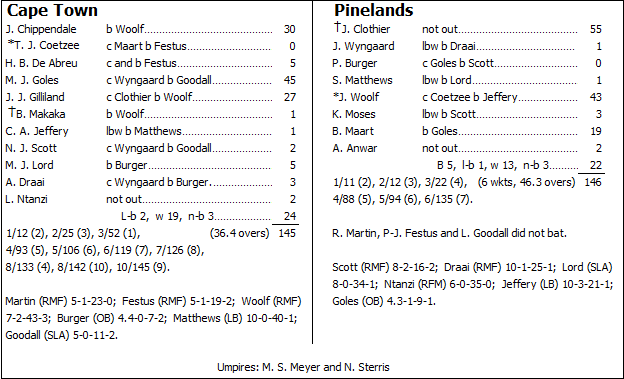
There were several similarities between Cape Town’s 50-over match against Pinelands at the Boon Wallace Oval and their season-opening T20 encounter, and both ended similarly. Put in to bat first under heavily overcast skies on a slightly sluggish pitch, the Cape Town batting had the worst of the conditions – and ultimately failed to adapt sufficiently to post a defendable total.
Cape Town began promisingly though, as Josh Chippendale took twelve runs from the opening over without undue effort. But his new-ball partner Peter-John Festus struck back immediately for Pinelands, using the lack of pace off the pitch to hold up short deliveries that allowed him to strike in each of his opening two overs. It was an approach that provided the key to unlocking the home side’s batting weaknesses, as a slew of batters would subsequently fall in popping up catches by failing to keep mistimed strokes down.
But that still lay somewhat in the future. For the immediate, Chippendale middled enough drives to hit six fours before dragging on, after which Justin Gilliland pounced on two consecutive horrendous long hops to dispatch them both for six. With player-coach Mathew Goles at the other end carefully laying out his stall, the home side was consequently able to proceed to a decent 85-3 by the first drinks break – at which point they were scoring at a healthy five to the over.
That rate was to continue for the first half of Cape Town’s over allotment, helped by a shower of wides and a sprinkling of no-balls from visiting skipper Jordan Woolf in particular. But he also broke through the last of the home side’s organised resistance, adding the scalp of Gilliland to that of Chippendale. His three wickets in seven overs consequently exposed Cape Town’s fragile middle order – an opening which left-arm spinner Liam Goodall then exploited. Once he therefore lured anchorman Goles – who had stood firm throughout while watching five partners come and go at the other end – to also hole out, Cape Town had lost five for 40 in barely twelve overs, and the game’s whole complexion had changed. There were no further boundaries from the home side throughout the last hour of their innings, which off-spinner Petrus Burger then wrapped up 50 minutes ahead of the scheduled innings break by knocking over the last two wickets in consecutive overs.
Their early demise at least gave Cape Town a 40-minute window of opportunity prior to lunch to inflict some early damage of their own on the Pinelands batting line-up – which they grabbed with both hands. Although the visiting batters were much less inclined to give away their wickets with uppish strokeplay, Cape Town nevertheless successfully pried out their top order anyway – and at 22-3 after ten overs at lunch, the game was very much in the balance.
But fortune swung irretrievably away from the home side once play resumed – by which stage the clouds had all passed on and the sun was shining down brightly. Opening bat Jason Clothier patiently entrenched himself firmly at one end to become an immovable obstacle, while Woolf at the other end accepted enough loose deliveries to provide his side with a momentum-inducing series of boundaries. Within 45 minutes of the resumption as a result, the pair had added a vital fifty runs together to put Pinelands on top. Although Craig Jeffery – making his 100th Cape Town First XI appearance, and who would go on to bowl his most economical ten-over spell of that career – eventually dismissed Woolf shortly after the latter had slog-swept his second six, that position of dominance was not thereafter surrendered.
Opening bowler Nicholas Scott did nip out a second scalp soon afterwards, leaving the visitors with some work yet to do at 94-5, but with Clothier completely sealing up his end, the required breakthroughs just wouldn’t come. As the asking rate began at a moderate level, and remained that way throughout, Pinelands were never under scoreboard pressure – and refused to be tempted into the heedless pursuit of quick runs. Clothier and his new partner Barry Maart showed absolutely no interest in attempting a bonus-point win. Quite content to gradually grind their way towards their target with ones and twos, they put the game to bed by adding a further 41 together in 15 overs. Eventually Maart lost patience with just eleven runs still needed, but Clothier stayed to the end, earning his reward of reaching a half-century (albeit from 121 balls) – the first conceded by Cape Town in the new season – and scoring the winning run with 3½ overs to spare.
Leave a Reply