
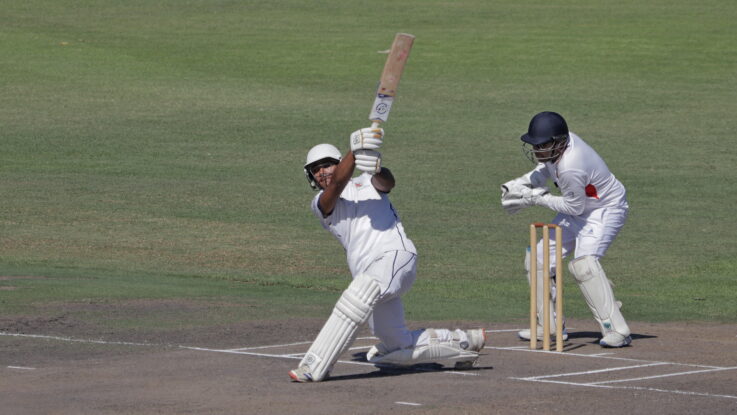
Read all about the first XI’s season here.
While it took a while to fully manifest, the steady erosion of the Cape Town Cricket Club First XI’s core experienced player base over the preceding two seasons finally came home to roost with a vengeance in 2025/26. The enforced changes to the squad going into the new 2025/26 season were not as dramatic as they had been the previous season, when no fewer than nine new players eventually debuted for the First XI, but the side would nevertheless field four more debutants during 2025/26 – and ultimately fully half of their squad of 20 players that represented the side during the season, began with fewer than ten First XI career caps to their name.
Still, that wasn’t the real issue, as an infusion of new blood into the squad is seldom a bad thing. Of far greater consequence was the missing bulk of their seam bowling component for the whole season, due to injury and other unavailability. For a team that had relied very heavily on its seam bowlers the season before (the pace brigade had taken fully 70% of the First XI’s wickets in 2024/25), this was a particularly crippling blow. This deficiency was partly mitigated by the arrival of youthful Lancashire opening bowler Jaden Rose a week into the new season, but it was never fully addressed – a limited bowling attack remained the side’s Achilles heel throughout. Specifically, the loss of two of their three regular opening bowlers of the preceding season, Nicholas Scott and Lloyd Wingrove (who had jointly topped the bowling averages in 2024/25, capturing 63 wickets between them at just 20 runs apiece) had at a stroke cleaved 165 matches and 219 career wickets’ worth of experience from the First XI’s resources before the first ball was bowled. Add to that the fact that Jonathan Draai – another seam-bowling regular of the season before, whose workload was such that he had sent down just one over fewer than leg-spinner Craig Jeffery – made just a single appearance in 2025/26, meant that it was left to Alex Draai to carry the seam attack. Thankfully he did so manfully, playing in every match and bowling more overs than anyone else in 2025/26, to top the wicket-taking stakes for the second successive season.
The net result was that, despite a promising start to the league – wins from their opening two matches shot the First XI straight to top of the Premier League points table until the last week of October – they would eventually suffer 17 league defeats (comfortably a 28-season record number for a single season), and had to beat newly-promoted Rylands in their final match to avoid finishing the season stone last. This they duly achieved, but in eleventh place still finished within the relegation zone. And while that would correctly indicate that most of the 2025/26 season was a hard slog for an often outgunned First XI, almost imperceptibly the turning point of their season had occurred in late November already. Then, a rare mix of unfavourable circumstances all combined to have their on-field victory over Ottoman subsequently overturned on appeal, due to a discrepancy on the submitted team list for the game. The points thus forfeited – and awarded to an also-struggling Ottoman side instead – ultimately made all the difference in whether it was Cape Town or Ottoman who would join Rylands as the two sides earmarked for relegation to the First Division A in 2026/27. For now it is Cape Town that faces that undesirable fate, but with the club finding grounds to contest the overturned result, legal proceedings have been instituted. As at the time of writing the matter is still sub judice, so whether the First XI returns to the Premier League to contest another season in 2026/27 remains an open question for now.
So where did it all go wrong? While the First XI’s batting certainly wasn’t brilliant (their overall average of 18.83 was their lowest in three seasons), it was no great surprise that their greatest problems lay with the bowling. The First XI’s 2025/26 overall bowling average of 28.01 runs paid per wicket taken has been exceeded only once in the past 28 seasons (and that was back in a time where they could win just a single match all season), and their 4.78 runs conceded per over on average was the worst in any of those seasons. In addition, the 105 sixes struck off their bowlers during the season, and the 29 fifty-plus partnerships that opposition batters compiled against them, were both also the joint-highest in that time. While there were some bright moments along the way (it was the first time in six seasons that the First XI collected as many as four five-fors), they were too few and far between. Early on, against eventual league winners Durbanville, for the first time in 28 seasons they managed just a single wicket in a full 50 overs bowled (a debacle that ended their brief reign in top spot on the log), won just twice on home soil all season, and suffered both home and away defeats against six of their eleven opponents (although they did return that particular favour against the University of the Western Cape at least).
But it wasn’t all doom and gloom for the First XI in 2025/26, and they were competitive in the shorter T20 version of the game, with which the season traditionally begins nowadays. Their first match against runners-up from the preceding season, Durbanville, was a notable improvement over their corresponding clash the season before. While the First XI still went down to the province’s strongest club of the past decade, they at least denied them a bonus point. Cape Town then chased down a daunting total of 160 with ease against Green Point the next day, thanks to an unbeaten 114-run stand in 12 overs between Mathew Goles and Josh Chippendale, and then decimated a scratch Rondebosch outfit the following weekend, reducing them to 25-6 as Alex Draai took only the second five-for ever achieved in a T20 match involving the First XI. Skittling Rylands for 77 later that same day put Cape Town in line for a semi-final booth, especially once they held Bellville to 126 in their final round robin game. However, the batting then failed on a difficult pitch – causing a three-way tie with Green Point and Bellville for the second qualifying spot in their pool. Green Point claimed that on run rate considerations, and finished as runners-up to eventual competition winners WPCC.
As has been mentioned, even the 50-over fare began well for the First XI. Arriving in time for their opening encounter against Green Point, Rose became the first member of the side since 2015 to take a five-for on First XI debut, after which skipper Tristan Coetzee and Jamie Marillier smashed 115 off the first 13 overs of Cape Town’s chase to set up a bonus-point win. UWC were then dispatched comfortably enough the following weekend to keep the First XI at the top of the standings, before they were badly outplayed by Durbanville in round three to concede the lead to them. Further defeats at the hands of Brackenfell and newly-promoted Victoria then sent the First XI into a downward spiral that dropped them to seventh place by early November, before their best batting effort of the season – spearheaded by a maiden First XI century from Chippendale – against WPCC and the ill-starred win over Ottoman stabilised things for a while. But thereafter the wheels came off – a devastating assault on their bowling by Claremont’s Daniel Smith brought heavy defeat in their next match, triggering another far worse losing streak in which they won just once (again over UWC, thanks to more fine batting by Coetzee and Chippendale) in their next eleven matches. That disastrous run dropped the First XI into the relegation zone by the end of November already, and by the time they faced up for the return match against Claremont (without Smith in their ranks this time) on the last day of February, they were bottom of the table – a full six points behind eleventh-placed Rylands. A rain-affected DLS win over Claremont in that game kept the First XI’s theoretical hopes of escaping relegation alive, with three games left to play, but unfortunately both Bellville and Rondebosch then monstered their bowling in the next two games to leave on-field results incapable of saving them.
But while the team as a whole suffered, there was still scope for individuals within the squad to demonstrate their worth. Scorer of the side’s sole century of the season, besides two other near-misses, Chippendale took his First XI career tally passed 1 000 runs in his second season for the club, and in his 50th appearance for them in the final match of the season, he hit enough early boundaries in Cape Town’s small victory target to keep his nose ahead of Goles and finish as the side’s leading run-scorer for the season. At the club’s annual awards dinner, he was also recognised as the most diligent at practices and the First XI’s Best Fielder. Goles himself passed 200 appearances for the side, and in that definitive Ottoman match towards the end of November, he passed Dominic Telo’s record of 5 319 runs to become the First XI’s leading overall run-scorer of the past 28 seasons. He was rewarded with both the prestigious President’s Cup and the Club Cricketer of the Year awards at the club’s annual awards dinner. Coetzee was the other member of the batting’s top triumvirate, hitting a 90 and two 80s and he cruised passed 2 500 career runs for the side. In the process he broke his own record of the season before (then tied with Andrew Saunders) for the most runs scored by a First XI captain in a season, and by playing in every match in 2025/26 has extended his run of consecutive matches as the First XI captain to 40 – now just four short of equalling the record set by Geoff Dod’s unbroken run between December 2017 and November 2019.
The only other batter in the squad to threaten 500 runs was Justin Gilliland, who missed most of the first month due to personal reasons, but then quickly made up for lost time by hitting 61 upon returning and then two 70s. He is rapidly approaching 1 000 career runs for the First XI himself. Of the rest, Hilio de Abreu reached 150 First XI appearances and passed 2 500 career runs in an otherwise quiet season for him, Jeffery did not miss a single game for the second successive season (he is currently on a 55-match streak of consecutive First XI appearances, stretching back to March 2024), and is now within touching distance of 100 caps and 1 000 runs for the side, Marillier initially formed half of an aggressive and initially successful opening stand with his captain (the First XI never once repeated the successful opening partnership of Coetzee and Goles of the previous before), before falling away in form, Michal Lord played some useful knocks towards the end of the season, including a career-best 65 in a losing cause against Bellville, Lukanyo Metu chipped in with several 20s in an injury-hit season, and Alex Draai hit a maiden fifty against Durbanville to secure the Game-Changer trophy at the annual awards dinner.
As already stated, the going was harder on the bowling front – and the gaps between players larger. As already stated, Alex Draai was again the First XI’s top wicket-taker, but only Rose provided any competition in the seam bowling department. Draai was peerless in the AMA20/20, bagging 13 wickets at barely nine runs apiece, when no other First XI bowler took more than five. That format included three wickets in his final over against Green Point, and another three in his first over against Rondebosch. His new-ball partner Rose played little part in the T20 campaign, where his spot as the one overseas player permitted in the side was more often given to left-arm spinner Joe Stevens. Rose began electrifyingly in the 50-over fare though, bagging a five-for on debut and then taking a second one less than a month later. While this start ultimately kept him top of both the side’s wicket-taking tally and averages in the Limited Overs competition, his economy rate hovered around worrying levels.
The spin department revolved primarily around Jeffery’s leg-spin and Lord’s left-arm orthodox fare, and they generally matched each other well throughout – Jeffery taking marginally more wickets, while Lord was more economical. Jeffery’s highlight was a maiden five-for (albeit an expensive one) against WPCC, but that apart there was only one other four-for in a season where regular small returns were his usual norm. Still, he reached 50 career wickets for the First XI in the process. Lord achieved the same milestone, completing the First XI double of 500 runs and 50 wickets with two games to spare. His bowling returns were even more marginal than Jeffery’s though, with just a single three-for to his name – until he wrapped up the Rylands tail in short order on the season’s final afternoon to record a career-best 4-7. But both kept Alex Draai honest in the stakes for top all-rounder, that honour remaining up for grabs right up until the end of the final game. While Stevens bagged a cheap three-for against Rylands in the AMA20/20 to stay top of the overall bowling averages, that was also his swansong – he never played in the 50-over competition. That left off-spinner Jade Schoeman as the only other tweaker of note. He had a decent debut in helpful conditions in the ill-fated Ottoman game, but then struggled against aggressive opposition batters, leaving a pair of two-fors against Rylands as his best contributions.
So, despite some encouraging AMA20/20 success early on – which was itself a big improvement on the First XI’s historical tribulations in this format since 2020 – a good deal of soul-searching remains to be done during the winter months preceding the 2026/27 season. While restocking the seamer cupboard is a pressing need, in truth the spinners hardly excelled either, producing very similar returns to the seamers in 2025/26: 82 wickets @ 28.67 runs each at 4.71 runs to the over, versus 87 wickets @ 27.38 apiece and 4.85 runs an over by the quickies. Both indicate a lack of bowling penetration that the stats confirm: the opposition batting line-ups averaged 30.24 across their first six wickets, and produced 28 fifty-plus partnerships, while Cape Town’s own top six by comparison averaged 23.56 and managed just 19 fifty-plus partnerships. This indicates required work in the batting department too. Part of the problem was a lack of a settled contributor in the number two batting berth, whose incumbents averaged only 16.81 all season. That is even more limiting in a side that relied heavily on its top five for run-scoring: the overall batting average from number six to eleven in the line-up was, to put it mildly, a rather disappointing 9.96 (with just two 50-plus scores achieved between them from 101 dismissals).
While the First XI were unlucky in 2025/26 to be denied the services of key all-rounders through no fault of their own, they also didn’t really respond proactively in addressing this: in several games in 2025/26, the First XI had to rely on a collection of bits-and-pieces bowlers to complete the fifth bowler’s quota. Unfortunately, bolstering the ranks with fresh blood is often dependent on whether the side remains in the Premier League in 2026/27. But the First XI has overcome relegation before. Notwithstanding the undoubted blow that relegation is to the club’s prestige, and its accompanying inherent risk of losing existing key players to other clubs, thereby making the task of regaining Premier League status so much harder, it also offers opportunity. The opportunity to explore new frontiers, rediscover winning ways and rebuild confidence, as operating in the First Division A means a league in which the pressures and cost of mistakes should not be as brutal as the First XI experienced in 2025/26.
Leave a Reply